Integrated Systems Model of Civilization
A comprehensive theoretical framework that reveals how different aspects of civilization interact across multiple layers, with explicit mapping of dependencies, feedback loops, and emergent properties. This integrated model enables deeper understanding of historical dynamics, interpretation of contemporary challenges, and more effective navigation of humanity's complex future transitions. Through structured analysis of both transformation drivers and system properties, the framework provides analytical tools for researchers, policymakers, educators, and individuals seeking to understand large-scale social change within its full context.
Purpose of This Knowledge Base
This website serves as an interactive exploration of civilization dynamics through an integrated systems lens. It provides a structured framework to understand how civilizations operate as multi-layered complex adaptive systems that evolve through time. The model synthesizes insights from history, anthropology, complex systems theory, ecology, and economics to create a coherent understanding of how different aspects of human civilization interact across multiple scales and domains.
Traditional disciplinary approaches often address civilization components in isolation—studying technology without culture, or institutions without their environmental context. This integrated model reveals the crucial interdependencies between these domains, helping explain why civilizations develop along certain trajectories, why they sometimes fail, and how they might successfully navigate transitions. By understanding these system dynamics, we gain both explanatory power for historical patterns and navigational tools for future challenges. The approach is particularly valuable for addressing contemporary challenges that span multiple domains, from climate change and technological disruption to institutional adaptation and cultural evolution.
The framework is organized around three kinds of question: what forces drive large-scale change (Transformation Drivers), what structural properties shape how systems respond (System Properties), and how these concepts apply to specific problems (Analytical Applications). The three sections below address each in turn.
The Four-Layer Model
Civilizations can be understood as complex adaptive systems with four interacting layers, each enabling and constraining the others. These layers represent different aspects of social organization and technological capacity that co-evolve over time, with both bottom-up and top-down influences creating the dynamic patterns we observe throughout history. While each layer can be studied separately, the most powerful insights emerge from analyzing their interactions and interdependencies that create integrated civilization systems.
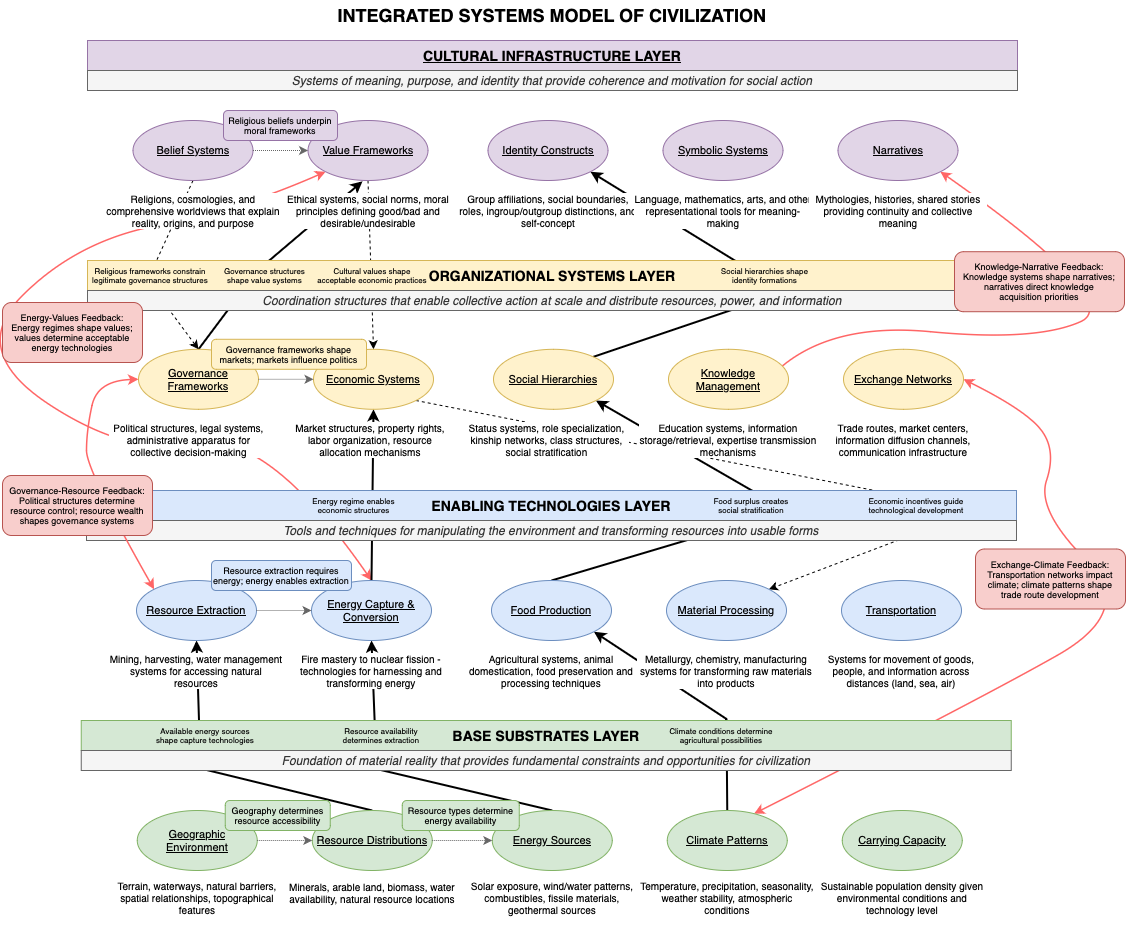
Cultural Infrastructure Layer
Systems of meaning, purpose, and identity that provide coherence and motivation for social action
Organizational Systems Layer
Coordination structures that enable collective action at scale and distribute resources, power, and information
Enabling Technologies Layer
Tools and techniques for manipulating the environment and transforming resources into usable forms
Base Substrates Layer
Foundation of material reality that provides fundamental constraints and opportunities for civilization
Understanding Each Layer
Cultural Infrastructure Layer
The cultural infrastructure forms the highest layer in our model, providing the meaning systems, identity frameworks, and normative structures that guide human action and give coherence to social life. This layer has evolved through distinct historical stages from animistic frameworks in hunter-gatherer societies to universalizing religious systems in agricultural civilizations to increasingly secular-rational frameworks in industrial societies, each producing different frameworks for how societies understand authority and legitimacy. Despite being most distant from material reality, cultural systems exert profound influence by determining what activities are considered valuable, legitimate, and meaningful, often shaping how technologies are used and which institutional forms can develop.
- Belief Systems: Frameworks for understanding causality, reality, and humanity's place in the cosmos that shape perception and decision-making. Ancient Mesopotamian cosmologies (circa 3000 BCE) explained flood cycles as divine actions, leading to temple-based water management systems, while contemporary scientific frameworks enable predictive hydrological models used for secular infrastructure planning. The transition from religious to scientific causality during the European Enlightenment (1650-1800 CE) transformed approaches across domains from medicine to agriculture, replacing supernatural explanations with mechanistic models that enabled new forms of technological and institutional development.
- Value Frameworks: Hierarchical preference structures that guide moral judgments, determine goals, and establish priorities within societies. The transition from honor-based to rights-based value systems between 1600-1800 CE transformed European judicial practices from ritualized combat to evidence-based procedures, while also reshaping concepts of legitimate governance from divine right to popular consent. Contemporary value transitions toward post-materialist frameworks—more prevalent among younger cohorts in advanced economies—are reshaping economic priorities from growth maximization toward well-being and sustainability.
- Identity Constructs: Definitions of self and group boundaries that structure social belonging, obligation patterns, and cooperation networks. Tribal identity systems typically limit full moral consideration to groups of 500-2,500 individuals with kinship connections, while national identity frameworks expanded cooperation circles to encompass tens of millions of strangers through shared symbolic systems. Modern identity expansion continues through global frameworks like universal human rights, which have been incorporated into all UN member state constitutions drafted since 1948, though implementation varies substantially. These identity expansions enable larger-scale coordination while creating new integration challenges.
- Symbolic Systems: Tools for representing, communicating, and manipulating meaning that enable knowledge transmission across time and space. The development of cuneiform writing in Mesopotamia (circa 3200 BCE) enabled administrative record-keeping that supported cities of 40,000+ residents compared to the 150-500 person maximum of purely oral cultures. Mathematical notation systems like the Hindu-Arabic numerals (introduced to Europe circa 1200 CE) enabled computational capabilities impossible with Roman numerals, accelerating scientific and commercial development. Contemporary computational symbolic systems continue this evolution, with algorithmic language capable of processing information at scales beyond human cognitive capacity.
- Narratives: Structured story forms that integrate events into meaningful patterns, providing temporal orientation and interpretive frameworks. Cyclical time narratives dominant in agricultural civilizations (circa 3000 BCE - 1500 CE) emphasized maintaining traditional practices aligned with natural cycles, while progressive narratives emerging in early modern Europe (circa 1650-1800) legitimized innovation at historically novel rates. Contemporary narrative conflicts between techno-optimist and ecological collapse frameworks shape divergent policy approaches to environmental challenges, demonstrating how core narratives function as competing attractors for interpretation of complex data and events.
Cultural systems change more slowly than technology or institutions—which makes them the backbone of resilience during crises and a source of friction when material conditions shift faster than meaning systems can follow.
Organizational Systems Layer
The organizational systems layer encompasses the social structures, institutions, and coordination frameworks that enable collective action at scale beyond the limitations of personal relationships. This layer translates cultural values into operational reality through formalized patterns that establish how decisions are made, resources allocated, information processed, and conflicts resolved. Institutional evolution from kinship-based systems to bureaucratic states to network governance approaches reflects the increasing scale and complexity of coordination problems throughout civilization history, with each transition enabling larger-scale collective action while introducing new organizational challenges.
- Governance Frameworks: Systems for collective decision-making and rule enforcement that establish how communities resolve conflicts and coordinate joint action. The transition from personal to institutional authority between 1500-1800 CE transformed European governance from patrimonial systems dependent on ruler characteristics to bureaucratic structures with procedural consistency and role permanence beyond individual officeholders. This shift increased governance stability while reducing flexibility—Prussian bureaucracy maintained continuity across multiple rulers but grew elaborate and resistant to change—consistency without flexibility. Contemporary governance continues this evolution with the development of multi-level frameworks like the European Union that coordinate across previously sovereign domains, addressing issues like environmental policy where national action alone is insufficient.
- Economic Systems: Mechanisms for organizing production, exchange, and distribution of goods and services that establish how material needs are met. Economic coordination evolved from reciprocity-based gift economies in small-scale societies (typically <150 members) to redistributive command systems in early states (3000-1000 BCE) to increasingly market-based arrangements that now mediate most global economic activity. Money systems, first developed as standardized accounting units in Mesopotamian temples (circa 3100 BCE), transformed into physical tokens, then credit instruments, and now digital abstractions where most currency exists only as electronic records—each stage increasing coordination capacity across distance and time while creating new systemic risks.
- Social Hierarchies: Structures that distribute status, authority, and resource access among population members, shaping both individual opportunities and systemic incentives. Agricultural civilizations predominantly featured rigid status systems where birth largely determined social position, while industrial societies developed more fluid achievement-based hierarchies where intergenerational mobility increased substantially, though parent-child status correlation remained significant. Contemporary hierarchy systems feature distinctive domain specialization with separate status ladders for economic, political, cultural, and technical achievement, increasing system complexity while reducing status clarity. These structural arrangements shape both individual motivation and large-scale resource allocation patterns that determine which activities receive societal investment.
- Knowledge Management: Institutions and practices for generating, validating, preserving, and transmitting information across space and time. Knowledge systems evolved from person-to-person oral transmission—where information transformed and degraded across generations—to manuscript cultures with centralized repositories, to printing-based distributed systems, to contemporary digital networks with near-zero marginal distribution costs. Each transition increased knowledge preservation fidelity and access while creating new challenges in validation and authority. Modern scientific institutions now produce millions of new academic papers annually, enabling rapid knowledge accumulation while creating specialization barriers that hinder cross-domain integration.
- Exchange Networks: Patterns of connection that facilitate flows of materials, people, ideas, and values between communities across space. Exchange networks evolved from 25-50 km radius local trading patterns in early agricultural societies to regional networks spanning 500-1,000 km by the Bronze Age (circa 2000 BCE) to early global connections via maritime routes (circa 1500-1800 CE) to contemporary systems with the large majority of global trade by volume traveling via sea—typically cited at above 80% by weight (UNCTAD Review of Maritime Transport)—much of it through standardized container shipping networks. These networks create both tremendous resilience through resource complementarity and critical vulnerabilities through complex interdependencies, as the pandemic-related supply chain disruptions of 2020-2022 demonstrated when congestion cascaded across major ports worldwide.
Organizational systems occupy an intermediary position between cultural ideals and material realities—they must maintain legitimacy while achieving practical effectiveness within technological constraints, which makes them both the primary site of adaptation during transitions and the most common failure point when adaptation demands exceed institutional capacity.
Enabling Technologies Layer
The enabling technologies layer comprises the tools, techniques, and systems for manipulating the material world to serve human purposes, translating theoretical knowledge into practical capabilities. This layer has evolved through distinct technological regimes from stone tools and fire management (circa 400,000-10,000 BCE) to agricultural systems and metallurgy (10,000-3000 BCE) to mechanical systems and chemical processes (1700-1900 CE) to electronic and digital technologies (1900-present), each producing socio-material conditions that reshape possibilities across all civilization domains. Technological development follows identifiable patterns including acceleration within mature domains, punctuated transitions between dominant paradigms, and increasing interdependence between specialized subsystems.
- Resource Extraction: Technologies for obtaining raw materials from the environment that determine what substances are available for human use, at what energetic cost, and with what ecological impacts. Mining techniques evolved from surface collection and shallow pit mining (pre-3000 BCE) with depths under 10 meters to the Roman deep shaft techniques (circa 50 CE) reaching 150-200 meters to contemporary operations exceeding 4,000 meters below surface. Each advance increased accessible resource stocks while requiring greater energy inputs and technical complexity—modern mining equipment used in open-pit operations like Chile's Chuquicamata copper mine processes approximately 175,000 tons of material daily, enabling material flows at scales that create substantial environmental externalities with tailings sites visible from orbit.
- Energy Capture: Systems for harnessing, converting, and utilizing energy sources that establish fundamental limits on civilization's work capacity. Energy regime transitions from human power (roughly 0.1 kW per worker) to animal systems (0.5-2 kW per animal) to mechanical heat engines (10-1,000+ kW per machine) increased available power dramatically, enabling transformation across agriculture, manufacturing, and transportation. (Power figures from Vaclav Smil, Energy and Civilization, 2017.) Contemporary global energy systems convert approximately 600 exajoules annually from primary sources to end uses (IEA World Energy Statistics), with each transition in dominant energy sources (biomass → coal → oil → renewables/nuclear) requiring massive infrastructure investments—the current low-carbon transition requires annual investment in the range of several trillion dollars, on the order of a few percent of global GDP (IEA World Energy Outlook; IRENA World Energy Transitions Outlook).
- Food Production: Methods for cultivating, processing, and preserving food resources that determine both population carrying capacity and surplus availability for non-agricultural specialists. Agricultural systems evolved from early hand cultivation with seed yields of 2-4× input to Roman-era systems achieving 10-15× yields to modern industrial agriculture producing 30-40× seed yields in optimal conditions. The Green Revolution substantially increased global grain production between the 1950s and 1970s without comparable farmland expansion, enabling population growth from roughly 2.5 billion in 1950 to 7.8 billion by 2020 (UN Population Division) while urbanization rates rose from about 30% to 56% over the same period (UN World Urbanization Prospects 2022). Contemporary food systems display extreme specialization and globalization, with substantial volumes of calories crossing international boundaries before consumption.
- Material Processing: Techniques for transforming raw materials into useful artifacts and structures that extend human capabilities through properties unavailable in natural substances. Metallurgical advances from copper (circa 5000 BCE) to bronze (circa 3000 BCE) to iron (circa 1200 BCE) to steel (large-scale production post-1850 CE) enabled progressive improvements in tool hardness, durability, and sharpness that transformed everything from agriculture to warfare. Modern advanced materials science continues this trajectory with engineered substances like carbon fiber composites offering strength-to-weight ratios 3-5 times greater than aluminum and 7-10 times greater than steel, while nanomaterials manipulate atomic-scale structures to create properties impossible in bulk materials. These capabilities enable technologies from aerospace to computing that would be physically impossible using earlier materials.
- Transportation: Systems for moving people, goods, and materials across distances that determine practical limits of social scale, resource integration, and market development. Transport technology evolved from walking (5 km/h) to animal-powered systems (10-15 km/h) to sailing vessels (depends on conditions, average 8-10 km/h) to steam-powered systems (15-30 km/h) to internal combustion vehicles (30-100+ km/h) to jet aircraft (800-900 km/h), each transition collapsing effective distances and enabling larger-scale integration. Modern container shipping, handling the large majority of non-bulk cargo globally through standardized systems (UNCTAD Review of Maritime Transport), reduced freight costs dramatically compared to pre-containerization break-bulk shipping while substantially cutting port labor requirements—transforming global economic geography and enabling supply chain integration across continental distances.
Technologies embody cultural priorities while remaining constrained by physical laws—this dual position makes technological choices central to both what civilizations can do and what they do to their environments.
Base Substrates Layer
The base substrates layer constitutes the physical foundation upon which all other civilization systems depend, comprising both the unmodified natural environment and progressively transformed landscapes shaped by human activities. This foundational layer has traditionally represented a relatively fixed parameter within which civilizations developed, but has increasingly become an actively modified component of the integrated system as human capabilities expanded from local to global scales. Contemporary civilization now shapes baseline environmental conditions through mechanisms ranging from localized land conversion to planetary-scale alterations in atmospheric composition, creating novel feedback cycles between natural systems and human activities that operate across timescales from immediate resource constraints to multi-generational climate dynamics.
- Geographic Environment: Physical landscape features that shape human settlement patterns, transportation networks, and defensive possibilities through their spatial configuration. Riverine civilizations including Egypt, Mesopotamia, Indus Valley, and Yellow River societies all developed in specific geographic contexts offering complementary advantages: fertile alluvial soils, navigable waterways, natural irrigation potential, and defensible territories. Mediterranean civilizations utilized thousands of kilometers of coastline with abundant natural harbors to develop maritime networks enabling resource exchange across a vast area while maintaining political fragmentation that fostered institutional competition. Geographic advantages continue influencing modern development—landlocked countries face measurably higher transport costs than coastal nations (World Bank research on geographic disadvantage in development), while tropical disease patterns and climate conditions create persistent development differentials despite technological mitigation.
- Resource Distributions: Spatial arrangements of critical materials across landscapes that shape economic specialization, settlement viability, and exchange relationships. Uneven distribution of copper (concentrated in 5 major global deposits) and tin (primarily from sources in Cornwall, Iberia, and Southeast Asia) necessitated long-distance Bronze Age trading networks spanning 1,500-2,000 kilometers to supply essential metallurgical inputs. Coal deposits concentrated in Britain, Germany, and specific North American regions became determining factors in early industrialization patterns (1750-1850), with industrial centers clustering near accessible fuel where transport costs were lowest. Contemporary resource distribution remains significant despite globalization—rare earth element deposits are highly concentrated geographically, with China, Vietnam, and Brazil together holding an estimated 80-85% of known global reserves (USGS Mineral Commodity Summaries, 2023)—creating potential constraint points in technology transition pathways.
- Energy Sources: Available forms of environmental energy that can potentially be harnessed for human purposes through appropriate conversion technologies. Solar energy availability varies from approximately 800-1,000 kWh/m²/year in northern Europe to 2,000-2,500 kWh/m²/year in desert environments, creating nearly 3× differences in photosynthetic productivity and contemporary solar electricity potential. Wind resources similarly show geographic concentration, with optimal sites offering capacity factors of 45-55% compared to average locations at 25-35%, creating natural comparative advantages for wind energy development. Fossil energy sources—coal, oil, and natural gas—remain unevenly distributed, with approximately 65% of proven petroleum reserves concentrated in five countries (BP Statistical Review of World Energy), creating both geopolitical tensions and differential transition incentives in the contemporary energy landscape.
- Climate Patterns: Long-term atmospheric conditions including temperature regimes, precipitation patterns, seasonal variations, and extreme event frequencies that establish agricultural possibilities and adaptation requirements. Mid-Holocene climate stability (circa a 10,000-5,000 BCE) created temperature variations of approximately ±0.5°C across multiple centuries, providing the stable environmental conditions within which agricultural civilizations first developed. Regional climate variations create substantial agricultural productivity differences between optimal and marginal environments, driving specialization patterns in pre-industrial societies where most economic activities depended directly on climatic conditions. Contemporary climate change is increasing global temperature at approximately 0.18°C per decade (IPCC AR6), much faster than typical geological warming rates, while increasing extreme event frequencies in ways that challenge adaptation capacities in both ecological and human systems.
- Carrying Capacity: The maximum population size and consumption level that an environment can sustainably support given available technologies and resource management practices. Hunter-gatherer carrying capacities typically ranged from 0.1-1 person per square kilometer depending on ecosystem productivity, while early agricultural systems increased this to 10-50 people per square kilometer, enabling the first urbanization processes with cities of 5,000-10,000 inhabitants. Modern industrial carrying capacity expansions through synthetic fertilizer systems (increasing crop yields by 30-50%), fossil energy substitution for human/animal labor (replacing metabolic energy with mechanical systems), and global trade networks (enabling regional specialization) have supported a global population increase from approximately 1 billion in 1800 to 7.8 billion by 2020. This dramatic carrying capacity expansion remains dependent on continued high-throughput resource systems, creating questions about long-term sustainability as critical resources including phosphorus fertilizers and conventional petroleum face potential constraints—the duration of those constraints is subject to ongoing scientific and economic debate about reserve definitions and substitution possibilities.
The base substrates layer constitutes the physical reality within which all human activities occur. This layer has historically constrained development options through both absolute limits (physical impossibilities) and relative constraints (cost differentials) that shaped social organization, technological evolution, and cultural adaptations across diverse geographic contexts. The relationship between humans and this layer has changed dramatically over time—from early civilizations making minimal modifications to local landscapes, to industrial societies creating regional-scale environmental alterations, to contemporary civilization initiating planetary-scale changes in earth systems. This transformation has reversed the historical relationship: where stable natural systems once constrained human activities, human activities now alter natural systems in ways that feed back on civilization itself, requiring conscious management of earth systems rather than simple adaptation to pre-existing conditions.
Layer Interactions and Dynamics
Civilization systems operate through continuous interactions between layers that create both constraint patterns and possibility spaces. These dynamic relationships generate the distinctive evolutionary trajectories we observe throughout history—from periods of stability where cross-layer alignments reinforce existing patterns to transformative episodes where multiple layers undergo simultaneous reorganization. Understanding these interaction dynamics is essential for analyzing historical developments, interpreting current challenges, and anticipating future possibilities. Unlike disciplinary approaches that isolate technological, institutional, or cultural factors, this integrated perspective reveals how developments in one domain cascade across the entire civilization system through predictable yet complex transmission mechanisms that operate both upward (constraint patterns) and downward (directive influences).
Bottom-Up Constraint Patterns
- Base → Technology Constraints: Geographic features and resource distributions establish fundamental technological possibility spaces. Coal-based industrialization emerged first in Britain (1750-1830) partly because accessible coal deposits were often located near iron deposits and navigable waterways—reducing the cost of assembling industrial inputs relative to continental competitors. Similarly, hydraulic civilizations like Egypt, Mesopotamia, and early China developed in specific geographic environments with large river systems and predictable flooding patterns that enabled irrigation agriculture with yields 3-5 times higher than rainfall farming. These resource foundations direct technological evolution along specific pathways—the Chinese Song Dynasty (960-1279 CE) developed sophisticated high-temperature ceramic technologies rather than glass-making due to abundant kaolin clay deposits but limited high-quality sand and natron resources, demonstrating how varying resource landscapes create distinctive technological trajectories.
- Technology → Organization Constraints: Available technologies establish hard limits on viable organizational forms through physical communication and transportation constraints. Pre-telegraph governance operated at information transmission speeds that made message round-trips across empires the scale of Rome or the Mongols a matter of weeks to months—temporal constraints that necessitated substantial local administrative autonomy. Agricultural productivity similarly constrained urban population possibilities—pre-industrial farming supported only a small number of non-agricultural workers per farming household, strictly limiting urbanization rates without exceptional trade advantages. Contemporary digital communication technologies that transfer information at near-light speeds with near-zero marginal costs enable organizational forms like distributed global work teams, algorithmic governance systems, and massive online coordination that were physically impossible under previous technological regimes, demonstrating how each technological layer creates a bounded possibility space for organizational development.
- Organization → Culture Constraints: Organizational structures create selective pressures for compatible cultural frameworks and cognitive tools. Literacy rates in European societies rose substantially between 1500 and 1800, driven primarily by changing organizational requirements as commercial enterprises, state bureaucracies, and religious institutions increasingly required reading and writing capabilities. These organizational demands shaped cultural evolution toward text-based knowledge systems, linear-sequential cognitive patterns, and abstract representation capacities. Similarly, market-based economic organization selects for cultural frameworks emphasizing quantification, future orientation, and contractual thinking—cross-cultural research finds more future-oriented cognitive styles in societies with deep market integration than in subsistence communities. Specialized role distribution in complex organizations creates demand for standardized identity markers and fairness norms that operate beyond kinship boundaries, explaining why complex societies converge toward formal legal systems despite diverse cultural starting points.
Top-Down Directive Influences
- Culture → Organization Directives: Cultural value systems and meaning frameworks shape which organizational structures are perceived as legitimate and how they function in practice. Protestant Reformation regions in Europe (post-1517) developed distinctive organizational patterns with measurably higher literacy rates (Becker and Woessmann, "Was Weber Wrong? A Human Capital Theory of Protestant Economic History," Quarterly Journal of Economics, 2009), more participatory governance structures in both churches and towns, and lower corruption indices compared to Catholic regions with similar economic and geographic characteristics. These differences persisted for centuries and significantly influenced governance evolution trajectories. Similarly, Confucian value systems in East Asia created distinctive organizational patterns with comprehensive examination systems for official selection, detailed administrative procedures, and familial models of political authority—the Tang Dynasty civil service examination system (established 605 CE) created the world's first large-scale meritocratic bureaucracy, processing hundreds of thousands of candidates per examination cycle by the Song Dynasty (Elman, A Cultural History of Civil Examinations in Late Imperial China, 2000). Contemporary evidence from multinational organizations shows that despite standardized structures, actual operational practices vary substantially across cultural contexts, with cultural values determining how formal rules are interpreted and which organizational models gain widespread adoption.
- Organization → Technology Directives: Governance structures and economic systems direct technological development through incentives, regulations, and resource allocation decisions. Military priorities have consistently shaped technological trajectories—a large share of significant technological innovations between 1930-1970 received defense funding, including computers, jet engines, radar, nuclear energy, satellite systems, and early internet technologies. Patent system differences create measurable innovation pattern differences—pharmaceutical innovation concentrated in jurisdictions with strong patent protection while open-source software innovation flourishes in commons-based licensing environments, with millions of public repositories and vast communities of contributors. Chinese centralized research coordination during the Song Dynasty (960-1279 CE) created distinctive technological patterns emphasizing large-scale infrastructure and navigational technologies, while decentralized European innovation systems produced more rapid tool and machinery advances. These governance influences don't determine what innovations are possible but significantly shape which possibilities receive development resources.
- Technology → Base Directives: Technological capabilities increasingly modify the base substrate layer through environmental engineering, resource extraction processes, and atmospheric/hydrological system alterations. Agriculture has transformed approximately 50% of Earth's habitable land surface from native ecosystems to managed landscapes, altering species compositions, hydrological flows, and soil chemistry across continental scales. Fossil fuel technologies have increased atmospheric CO₂ concentrations by approximately 50% since pre-industrial levels (280 ppm to 420 ppm), while nitrogen fixation technologies have doubled the global nitrogen cycle, altering biogeochemical processes at planetary scales. Infrastructure construction creates concentrated material stocks that exceed natural distributions by orders of magnitude—the copper content in global electrical infrastructure represents a substantial share of all historically mined copper, creating an anthropogenic metal concentration without natural precedent. These technological modifications have effectively created what some scientists term the "technosphere"—a distinct component of the Earth system with mass exceeding 30 trillion tons that functions as a geological force comparable to natural processes but operating at accelerated timescales.
Emergent Cross-Layer Dynamics
- Co-evolutionary Development: Complex interdependencies between layers create selection environments where changes in one domain drive complementary adaptations in others through iterative feedback cycles. Writing systems and administrative structures co-evolved through mutual enhancement—early Mesopotamian proto-writing (3300-3000 BCE) began as simple accounting tokens tracking agricultural surpluses, then developed into more sophisticated cuneiform as administrative complexity increased, which in turn enabled more complex governance structures managing larger resource flows with greater precision. This co-evolutionary process transformed both domains through approximately 20 generations of incremental enhancements, with each advance in information technology enabling more sophisticated coordination that created demand for further information innovations. Similar patterns characterize the development of scientific institutions and experimental methodologies during the Scientific Revolution (1550-1700 CE), where new investigative techniques enabled institutional knowledge production that further refined research methods, creating an accelerating knowledge system through mutually reinforcing innovations in both domains.
- Misalignment Tensions: Different development rates across layers create persistent tensions when faster-changing domains outpace adaptive capacities in others, producing system stress that may either resolve through realignment or trigger crisis. Contemporary societies demonstrate significant misalignment between technological and institutional development rates—digital technologies have increased information processing speeds by many orders of magnitude since 1950 as costs fell comparably, while governance systems operating through legislative and regulatory processes maintain timescales measured in months to years with little change in underlying pace. This velocity differential creates governance gaps where regulatory frameworks often lag behind widespread technology deployment. Similar misalignments occurred during early industrialization (1780-1840) when manufacturing technologies transformed production processes at rates that outpaced both economic institutions and cultural adaptations, creating decades of significant social disruption before new institutional and cultural frameworks evolved to manage industrial relationships.
- Punctuated Equilibrium Patterns: Civilization systems typically demonstrate extended periods of relative stability punctuated by relatively brief but intense reorganization episodes where multiple layers undergo simultaneous transformation. Historical evidence suggests that most fundamental institutional change concentrates in comparatively short intervals—the longer quiet periods are when gradual pressures accumulate until threshold effects trigger cascading adjustments across multiple domains. The European transition from medieval to early modern systems (approximately 1450-1650 CE) compressed transformations across energy systems (expanded water power, early coal use), information technologies (printing press), governance structures (nation-state formation), and cognitive frameworks (empirical science) into a 200-year period following nearly 500 years of relative institutional stability. These punctuated patterns reflect threshold effects where gradual changes accumulate until critical transition points trigger cascading adjustments across multiple system domains, creating nonlinear change velocities that challenge both contemporary adaptation capabilities and retrospective causal analysis.
- Phase Transition Dynamics: When critical thresholds are crossed in multiple layers simultaneously, civilization systems can undergo rapid nonlinear transformations that reorganize relationships across all domains. The Industrial Revolution represented such a phase transition with mutually reinforcing changes across energy (coal/steam power), information (mass printing/education), organization (factory systems/mass markets), and cultural domains (scientific worldview/progress narratives). Historical phase transitions show both increasing turbulence approaching transition points and path-dependent outcomes strongly influenced by initial conditions. Comparative study of industrialization across multiple societies shows that while all experienced similar general transformation patterns, specific trajectories varied substantially based on pre-existing institutional arrangements and cultural frameworks—variations in labor organization, governance roles, and cultural adaptation that continue influencing development patterns more than 150 years later.
The relationship between information technologies and governance structures demonstrates clear cross-layer interaction patterns throughout history. Manuscript culture (500-1450 CE) required approximately 200-300 labor hours to produce a single book, creating information scarcity that concentrated knowledge in specialized institutions (monasteries, courts, universities) and reinforced hierarchical authority patterns based on controlled information access. The printing revolution (post-1450) dramatically reduced book production costs—by an order of magnitude or more relative to manuscript copying—increasing European book production from roughly 30,000 manuscripts in the 14th century to roughly 9 million printed books between 1450 and 1500 (Buringh and van Zanden, "Charting the 'Rise of the West,'" Journal of Economic History, 2009). This information abundance catalyzed religious challenges to centralized authority (Protestant Reformation), created growing middle-class literacy, and enabled new governance concepts based on wider information distribution. Contemporary digital technologies have further transformed this relationship by reducing information transmission costs to nearly zero while increasing production sources from a small number of publishers in 1950 to billions of potential information producers today. These changes correlate with documented declines in institutional trust across established democracies since the 1970s (tracked in OECD's Government at a Glance surveys and Gallup/Pew longitudinal polling) and emergent governance challenges from non-state actors with enhanced coordination capabilities. This case illustrates how changes in one layer (information technology) create selective pressures driving adaptation in another (governance structures) through predictable interaction mechanisms.
Layer interactions help explain why civilizations follow different developmental trajectories despite similar starting conditions: the particular configuration of each civilization's layers shapes how new pressures propagate through the system. Understanding these cross-domain dynamics is what distinguishes integrated systems analysis from single-factor accounts of historical change.
Key Transformation Drivers
Transformation drivers are major forces that propagate change across system layers, often originating in one layer but creating cascading effects throughout the entire system. Unlike incremental changes that improve existing processes, these drivers reorganize relationships between system components, enabling new possibilities while potentially destabilizing established structures. Studying these drivers reveals how civilizations evolve through history and helps anticipate future transformation pathways.
Energy Regime Transitions
Fundamental shifts in primary energy sources, conversion technologies, and distribution systems that reshape material capabilities and social organization. These transitions from biomass to coal to oil to renewable/nuclear sources transform transportation, manufacturing, and power relationships within and between societies through changed energy density, flow patterns, and access requirements.
Information Technology Revolutions
Major innovations in how information is captured, stored, transmitted, retrieved, and processed that transform knowledge management and cognitive capabilities. These revolutions—from oral traditions to writing to printing to electronic media to digital systems—reshape what information is available to whom, at what speed, and with what fidelity, affecting all aspects of social coordination.
Institutional Innovations
Novel coordination mechanisms that enable collective action at expanded scales or across previously unbridgeable boundaries. These innovations—from codified law to corporate structures to democratic governance—establish frameworks for aligning diverse actors toward common objectives despite conflicting interests, information asymmetries, and trust limitations.
Metacognitive Developments
Transformations in how societies think about thinking itself—the methods, validation systems, and conceptual frameworks used to structure understanding. These developments—including scientific method, systems thinking, and probabilistic reasoning—change how problems are formulated, what counts as evidence, what explanations seem plausible, and what solutions appear feasible.
Demographic Transitions
Shifts in population dynamics, urbanization patterns, and family structures that reshape social and economic organization. These transitions affect dependency ratios, settlement patterns, household composition, and intergenerational relationships while transforming labor markets, consumption patterns, innovation dynamics, and cultural transmission mechanisms.
Environmental Feedback Cycles
Complex interactions between human activities and environmental systems that create adaptive pressures, resource constraints, and transformation opportunities. These cycles—including resource depletion patterns, pollution accumulation processes, ecosystem service disruptions, and climate system alterations—demonstrate civilization's embeddedness in natural systems.
Major civilization transformations typically involve multiple drivers operating simultaneously, creating mutually reinforcing change vectors. For example, the transition from medieval to early modern Europe involved energy shifts (water/wind to coal), information technology (printing press), institutional innovation (nation-state formation), and metacognitive developments (scientific revolution). Contemporary civilization faces a similar multi-driver transformation period with concurrent shifts across all six driver domains—creating both compounding challenges and opportunities for intentional design before new patterns solidify.
System Properties
System properties are characteristics that govern how civilization systems operate, evolve, and respond to perturbations across all domains and time periods. Unlike transformation drivers that represent specific forces creating change, these properties describe the behavioral patterns and structural characteristics intrinsic to all complex adaptive systems. Understanding these properties helps explain why civilizations develop certain trajectories, display recurring patterns, and face common challenges despite diverse historical and cultural contexts.
Emergence & Self-Organization
How complex social formations arise from simpler interactions without central direction. Markets, cities, and languages all demonstrate how sophisticated order can develop through decentralized processes where individual actors following simple rules collectively generate higher-order patterns that no participant necessarily intended but which serve essential functions.
Path Dependency & Lock-In
How early developments constrain future possibilities through accumulated investments and self-reinforcing processes. Initial choices become increasingly difficult to reverse as complementary infrastructure, skills, and cultural practices accumulate around them, creating persistent trajectories that continue even when alternatives might offer superior performance.
Resilience & Fragility
How systems develop robustness to anticipated disruptions but vulnerability to novel threats. Optimization for efficiency often reduces adaptive capacity by eliminating redundancy and diversity, while specialization increases performance under stable conditions but creates brittleness when conditions change in unexpected ways.
Adaptation & Learning
How successful civilizations incorporate feedback mechanisms enabling responsive change. Adaptation involves both negative feedback processes that maintain system stability and positive feedback that enables transformation when needed. Effective learning systems distribute both information gathering and response capabilities throughout system components.
Scale Effects & Complexity
How system properties change qualitatively with quantitative growth. As civilizations expand in size and complexity, they encounter phase transitions where existing coordination mechanisms become inadequate, necessitating new institutional forms. Complexity increases energy and information processing requirements while creating new vulnerabilities.
Energy/Information Processing
How civilizations function as dissipative structures requiring energy throughput and information processing. All social complexity depends on capturing sufficient energy to maintain organization while efficiently processing information to coordinate activities across space and time. These requirements create fundamental scaling constraints.
These system properties interact in complex ways that create characteristic civilizational dynamics. For instance, emergence enables development of new organizational forms, which then become path dependent, affecting future adaptation capacity. Scale effects require increased energy and information processing, which creates new emergent behaviors at larger scales. Understanding how these properties interact provides a foundation for analyzing both historical patterns and contemporary challenges across diverse contexts.
Analytical Applications
This integrated systems model provides practical analytical tools for understanding historical patterns, interpreting contemporary challenges, and navigating future possibilities. The following methodological approaches apply the frameworks presented in previous sections to specific questions and contexts, enabling more effective sense-making and strategic orientation in complex environments. Each approach combines conceptual mapping with concrete analytical techniques that can be adapted to diverse domains.
Comparative Historical Analysis
Examining why similarly positioned civilizations followed different development trajectories by mapping system interactions across cultural contexts. This approach identifies how specific configurations of transformation drivers and system properties created divergent outcomes in comparable historical situations, providing insights into both developmental patterns and potential intervention points.
Transition Dynamics
Understanding how major transitions propagate through civilization systems and transform multiple domains. This methodology analyzes transition sequence patterns, acceleration mechanisms, resistance forms, and reconfiguration processes to better anticipate how current and future transitions may unfold. It helps identify effective intervention points for both accelerating beneficial transitions and mitigating disruptive effects.
Collapse & Resilience Assessment
Identifying critical dependencies and vulnerability patterns in complex systems to understand resilience limitations and potential failure modes. This framework examines how past civilizations experienced systemic collapses through cascading failures across system layers, then applies these insights to contemporary contexts to identify critical vulnerabilities and resilience-building opportunities.
Scenario Planning
Projecting alternative futures based on key uncertainties and system interactions to prepare for different potential outcomes. This approach identifies critical uncertainties across transformation drivers, maps their potential interaction patterns, and constructs integrated future scenarios that help organizations and societies prepare for multiple plausible futures rather than optimizing for a single prediction.
Innovation Ecosystem Mapping
Tracking technological interdependencies, knowledge flows, and coordination mechanisms to identify leverage points for systemic innovation. This methodology examines innovation as an emergent property of complex socio-technical systems rather than isolated breakthroughs, identifying where targeted interventions might catalyze broader transformation by addressing current bottlenecks or creating new possibility spaces.
Cultural Evolution Analysis
Analyzing how values, beliefs, and norms evolve and interact with material conditions across generational timescales. This approach examines cultural evolution mechanisms including variation generation, selection processes, and transmission systems to understand both historical cultural transitions and potential future cultural adaptation pathways in response to current transformation pressures.
How to Use This Knowledge Base
For Historical Understanding
Begin with the Key Transformation Drivers to understand major historical shifts, then explore Comparative Analysis to see how these played out differently across civilizations. The integrated model provides a framework for understanding why certain developmental pathways emerged in different contexts, and how transformation drivers interacted with existing system properties to create distinctive historical trajectories.
For Current Analysis
Use the System Properties framework to assess contemporary issues, identifying patterns of emergence, path dependency, and adaptation in today's challenges. Current transformations can be analyzed through the lens of multiple interconnected drivers operating simultaneously across system layers. This approach helps locate specific challenges within their broader systemic context, revealing both constraints and potential intervention points.
For Future Navigation
The Scenario Planning and Innovation Mapping tools provide methodologies for navigating future transitions and challenges. Understanding both transformation drivers and system properties helps anticipate potential futures and identify leverage points for effective intervention. This forward-looking application helps organizations and communities develop more robust strategies in the context of multiple interacting transitions.
We are currently experiencing what might be called a "meta-convergence"—a period where all six transformation drivers are simultaneously undergoing significant transitions. Multiple systems destabilizing simultaneously creates extraordinary challenges—and unique opportunities for intentional redesign before new path dependencies solidify. Understanding the integrated nature of these transformations is essential for effective navigation of this pivotal historical moment. This knowledge base aims to provide conceptual tools and practical methodologies for that navigation task.